Breaking Timelines at the Breakwater
May 12, 2026
By: Katie Grube
The Great Lakes feature more than 300 shore-connected breakwaters put in place to protect the coast from erosion, preserve the local ecosystem and shelter boats. The coastal city of Algoma, Wisconsin, borders Lake Michigan and features a south breakwater that is 1,530 feet long. In 2024, the U.S. Army Corps of Engineers led a project to repair the Algoma breakwater and stabilize the harbor’s structure. As the original structure was more than a century old, the fortification project involved breaking away 2 feet of damaged concrete before repouring the concrete and adding an additional 2 feet to the breakwater’s height.
Roen Salvage, a marine contractor with more than 75 years of experience, took on the challenging project. Using an excavator to break concrete, the team started work in August, and it became a race against the elements to finish before winter. With the clock ticking and demolition going slower than they wanted, Roen Salvage researched their options to fast-track the process. That’s when the company discovered Interstate Sawing & Demolition and their expertise in robotic demolition.
Getting Started
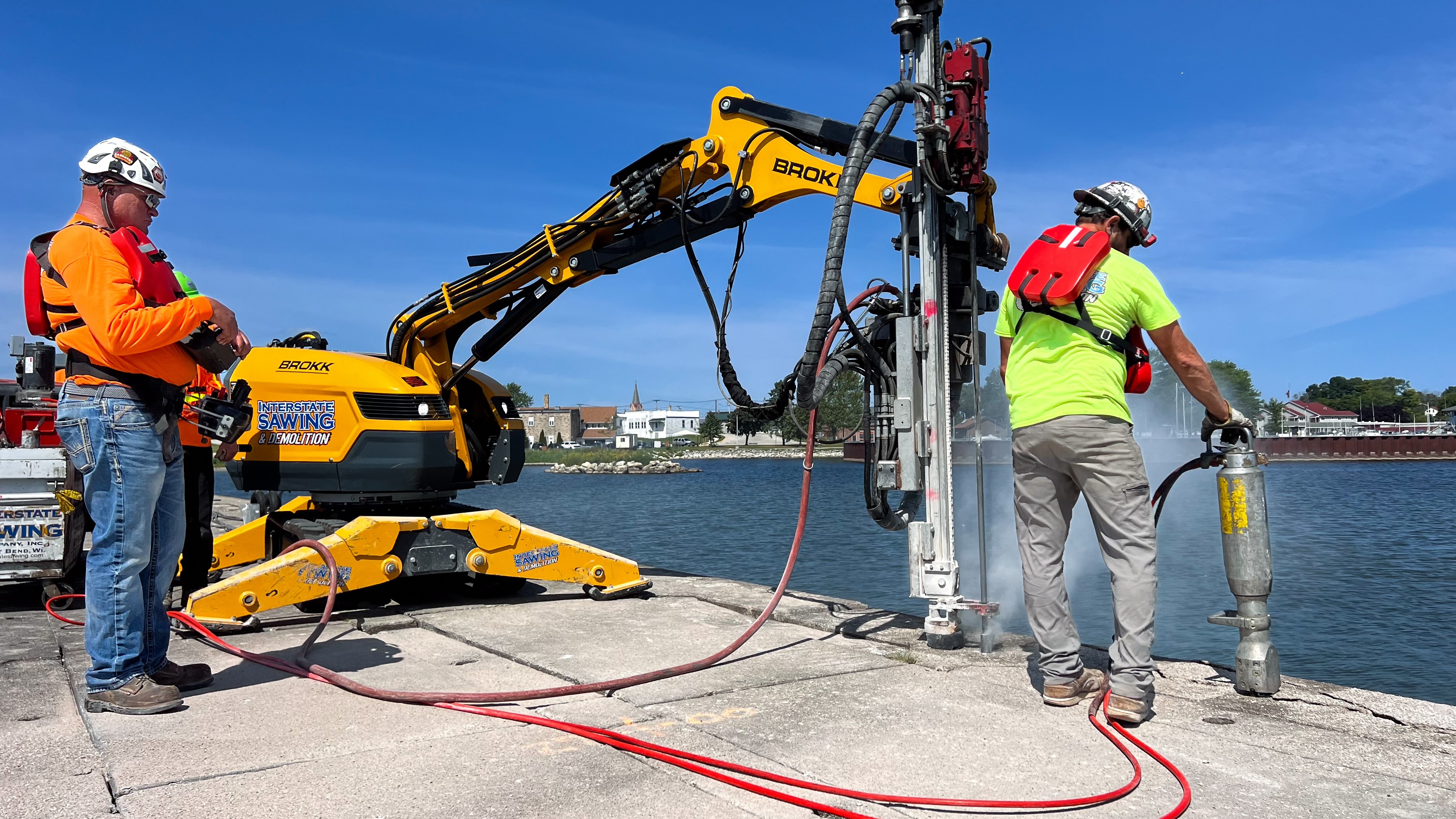 Any repair projects based on the Great Lakes need crews to account for the changing of the seasons. Winter can be brutal and poses risks to the equipment and workers in the area if the right precautions aren’t taken. While Lake Michigan doesn’t fully freeze over, shallow areas are more likely to see ice, making it hard to get barges through. The cold may also affect the repair materials. The Algoma breakwater project was no different. The U.S. Army Corps of Engineers and Roen Salvage knew they needed to finish before winter hit in October. However, finding the right equipment proved to be a challenge. The breakwater was only 8 feet wide, which eliminated the possibility of using a large excavator for the demolition. They needed a machine that could fit on the small space but also have the power to demolish the concrete quickly.
Initially, Roen Salvage used a 35,000-pound excavator equipped with a breaker attachment to dismantle the concrete. However, the fastest the excavator could safely go resulted in 20 feet of concrete removed per day. At that rate, it would take more than two months to complete the project, which would take them well into October. So, Roen Salvage approached Interstate Sawing & Demolition to see if they could break down the concrete faster.
“Roen Salvage got into contact with us through our website in late August. We went out to survey the scene,” says Sam Long, president of Interstate Sawing & Demolition. “Our team hadn’t worked on a breakwater before, but we specialize in limited access, confined spaces and other challenging projects. We knew we had what it took to complete the job in the allotted timeline, with safer, more efficient equipment. We were on location two days later.”
A New Approach
Interstate Sawing & Demolition started working with Brokk, the world’s leading manufacturer of remote-controlled demolition robots, in 2008. Since then, they’ve purchased 28 remote-controlled demolition robots that they use nearly daily. When taking on the breakwater project, the Interstate Sawing & Demolition team knew it had a few options capable of completing the work. Unlike excavators, Brokk robots feature enough power and maneuverability to break down the concrete with a breaker attachment, engineered to have a system that can provide the same amount of hitting power as an excavator up to three times its size. However, Long and his team decided they could go even faster if they added a Darda C12 splitter.
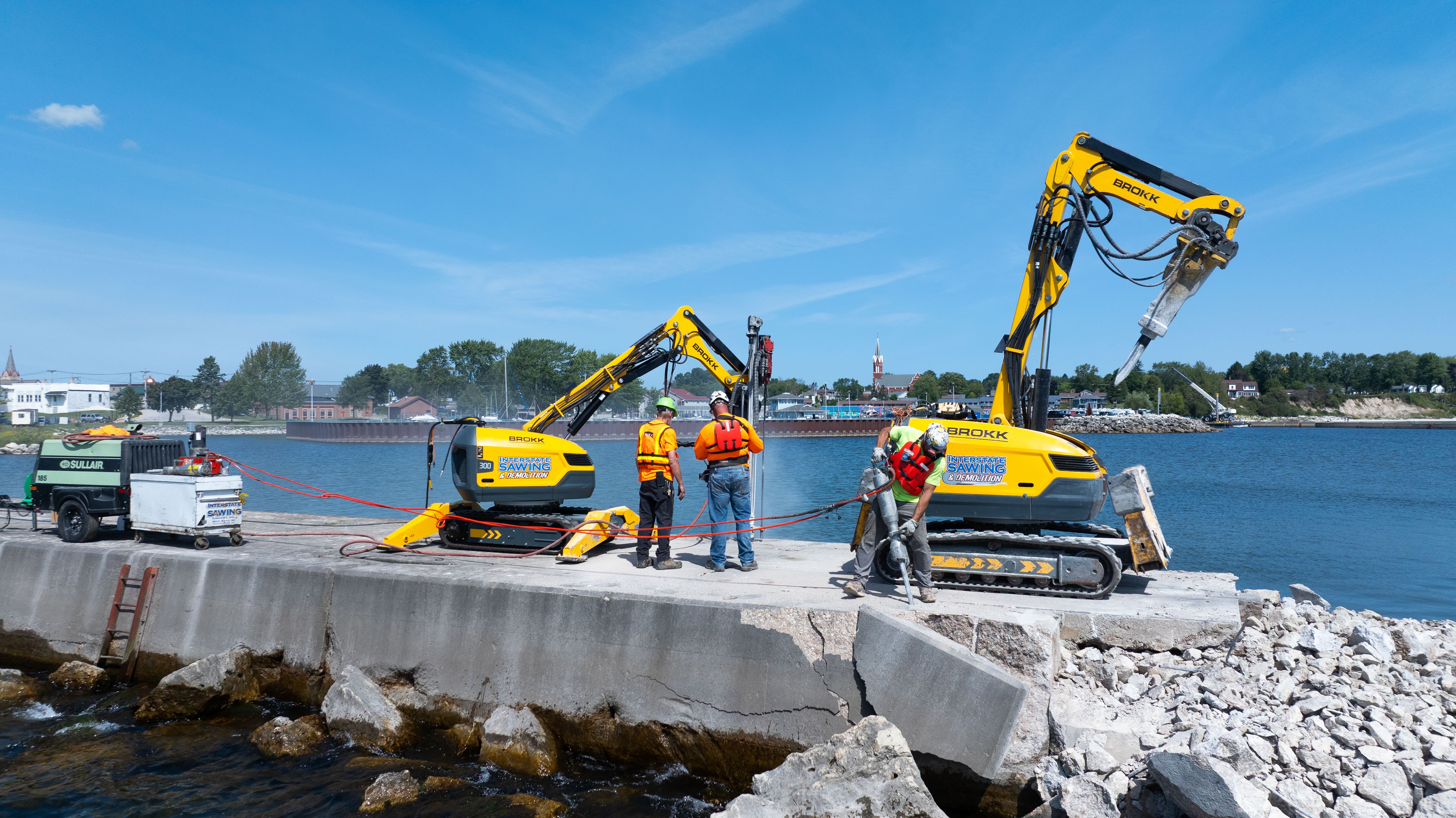 In the end, Sam Long’s team decided to use a Brokk 300, a Darda C12 splitter and a Brokk 500. One operator used the Brokk 300 equipped with a TEI 260 rock drill to drill holes into the concrete before another crew member with a Darda C12 concrete splitter came behind the machine to break the concrete from the inside out into large sections.
“We use the Darda splitters all the time in conjunction with the Brokk robots. When we’re breaking a thick machine pad or a footing in a hospital or a machine shop where you can’t have any vibration, that’s where this equipment comes into play,” Long says. “We can drill with the rock drill and split the concrete and fracture it up a little bit to create an air gap that allows for easier breaking and less vibration.”
They worked 20 feet at a time, putting 10 holes in the concrete on each side. Featuring hitting power up to 773 foot-pounds, the Brokk 500 came through with a BHB 555 breaker attachment to hammer the concrete into smaller, more manageable pieces. The three-part arm gave the Brokk more reach than a standard excavator and gave the operators the ability to break from more than one angle. Together, the Brokk robots and Darda splitter broke up to 150 feet of concrete to a depth of approximately 30 inches per day, making this process 7.5 times faster than the previously used excavator.
The Safest Option
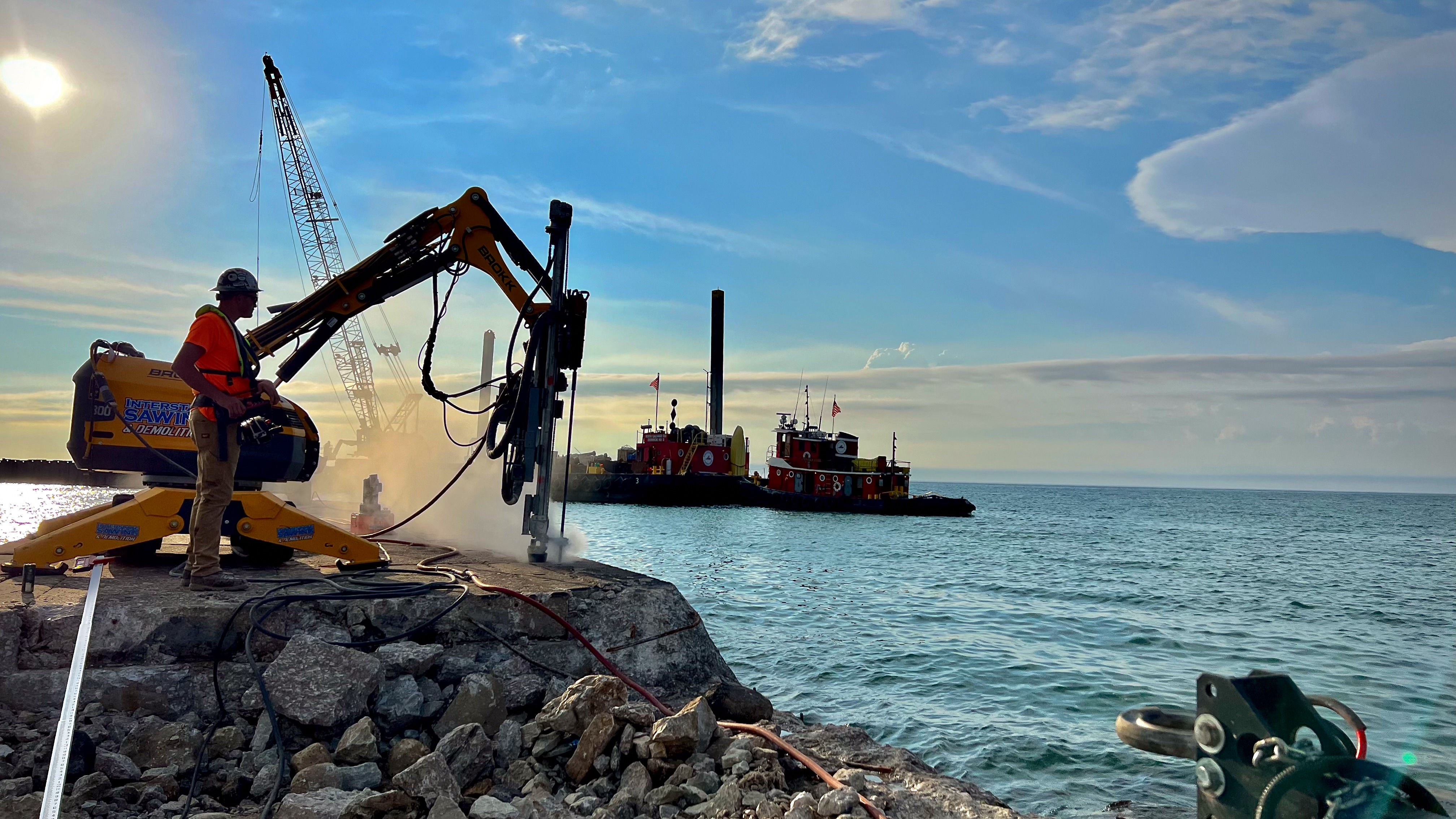 Since purchasing their first Brokk robot, Interstate Sawing & Demolition has seen a significant increase in safety during their projects. The company has the lowest safety rating possible for a company of its size in the construction industry and hasn’t had a lost-time injury since bringing on the robots. Haley Long, vice president of marketing and business development at Interstate Sawing & Demolition, says, “Our goal is to have all our crew members work to true retirement age. We ensure each project we work on meets the highest safety requirements available with the safest equipment. That wouldn’t be possible without Brokk.”
The remote-controlled operation of the Brokk robots means that the Interstate Sawing & Demolition crew members can be positioned to up to 984 feet away from the machine rather than operating from a cab. This gave them the chance to get out of the way of the broken concrete and remain at a safe distance while positioning themselves for an optimal view of the working area. Because the breakwater was narrow and the water was so deep, falling in was a risk and could pose significant danger to the operators. The remote operation of the Brokk placed them away from the edge of the breakwater, lessening the chances of a fall.
Roen Salvage followed the Interstate Sawing & Demolition crew and used a mid-sized excavator to pull debris out of the lake and load it into a barge. The barge then transported the debris to the disposal site. While the barge transported debris, the Roen Salvage team drove sheeting down under the breakwater to repour the concrete and create the new wall.
The Interstate Sawing & Demolition team worked 12-hour shifts for six days before they needed to pause and wait for the cleanup crew to catch up because the splitter and demolition robot combination was so efficient. They arrived on site on Aug. 23 and finished the first part of the project on Aug. 29. Then, after two weeks, they returned to the project for an additional three days. During that time, the crew removed about 1,320 feet of the breakwater, which totaled 420 tons of concrete.
A Prosperous Partnership
Interstate Sawing & Demolition and Roen Salvage finished demolition and rebuilding the breakwater by mid-September, well before the October deadline. The success meant that Roen Salvage and Interstate Sawing & Demolition plan to work on multiple upcoming projects, opening the doors to a successful, long-term partnership. “I have yet to be on a jobsite where someone didn’t come up to me and say, ‘I’ve never seen one of these,” Haley Long says. It just blows my mind. The future is here; it’s robotics for construction.
Job Stats
- Location: Lake Michigan
- Owner: U.S. Army Corps of Engineers
- Designer & Construction Management: Roen Salvage Co.
- Contractor: Interstate Sawing & Demolition
- Dates: August – September 2024
- Interstate Sawing & Demolition’s Duration: 9 Days
- Materials Removed: 420 tons of concrete
- Equipment: Brokk 300 with TEI 260 rock drill, Brokk 500 with 555 breaker, Darda C12 splitter, excavator and barge