Efficiency Is Key Element in Processing Plant Demolition
March 26, 2026

This article originally appeared in the Nov/Dec 2003 issue of DEMOLITION magazine.
When fire ravaged key components of the Farmland Foods processing plant in Albear Lea, Minnesota in February 2001, it was first thought that the plant could be rebuilt and eventually resume operation. Employing more than 500 workers, the facility was an integral part of Albert Lea’s agriculture- and livestock-dependent economy. However, damage to the plant proved so severe that Farmland opted instead to raze the site, a project that, since October of last year, has been headed up by Rogers, Minnesota-based Veit Inc.
A Huge Undertaking
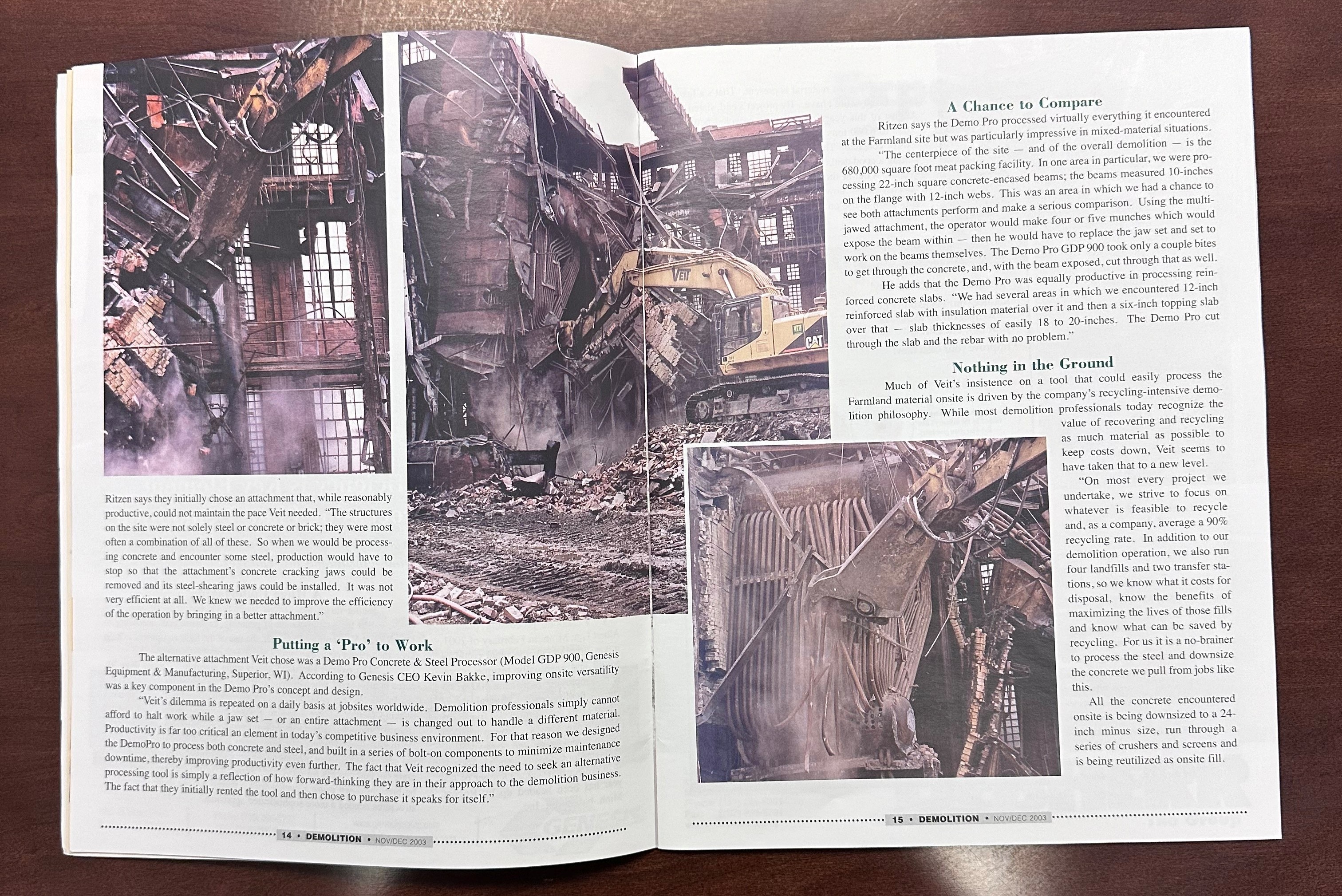
Taking down the various steel, brick and concrete structures on-site called for a combination of planning, expertise and, according to Don Ritzen, Veit’s project manager, the use of the right equipment to help keep the project on track.
“The overall Farmland site is quite sizeable — more than 30 acres in all — and, when in operation, featured four main structures: the stockyards, the boiler facility, an administration office and a massive meat packing facility. There was also a water treatment facility and several storage facilities that were slated for demolition. We knew from the outset that traditional demolition approaches such as a wrecking ball would not suffice here. There was simply too much material to bring down, separate out and process for recycling. Some of the smaller buildings could be brought down using a bucket with a thumb, but the more demanding structures needed a more sophisticated approach.”
Ritzen says they initially chose an attachment that, while reasonably productive, could not maintain the pace Veit needed. “The structures on the site were not solely steel or concrete or brick; they were most often a combination of all of these. So, when we would be processing concrete and encounter some steel, production would have to stop so that the attachment’s concrete cracking jaws could be removed and its steel-shearing jaws could be installed. It was not very efficient at all. We knew we needed to improve the efficiency of the operation by bringing in a better attachment.”
Putting a ‘Pro’ to Work
The alternative attachment Veit chose was a Demo Pro Concrete & Steel Processor (Model GDP 900, Genesis Equipment & Manufacturing). According to Genesis CEO Kevin Bakke, improving on-site versatility was a key component in the Demo Pro’s concept and design.
“Veit’s dilemma is repeated on a daily basis at jobsites worldwide. Demolition professionals simply cannot afford to halt work while a jaw set, or an entire attachment, is changed out to handle a different material. Productivity is far too critical an element in today’s competitive business environment. For that reason, we designed the Demo Pro to process both concrete and steel and built in a series of bolt-on components to minimize maintenance downtime, thereby improving productivity even further. The fact that Veit recognized the need to seek an alternative processing tool is simply a reflection of how forward-thinking they are in their approach to the demolition business. The fact that they initially rented the tool and then chose to purchase it speaks for itself.”
A Chance to Compare
Ritzen says the Demo Pro processed virtually everything it encountered at the Farmland site but was particularly impressive in mixed-material situations.
“The centerpiece of the site, and of the overall demolition, is the 680,000-square-foot meat packing facility. In one area in particular, we were processing 22-inch square concrete-encased beams; the beams measured 10 inches on the flange with 12-inch webs. This was an area in which we had a chance to see both attachments perform and make a serious comparison. Using the multi-jawed attachment, the operator would make four or five munches, which would expose the beam within, then he would have to replace the jaw set and set to work on the beams themselves. The Demo Pro GDP 900 took only a couple bites to get through the concrete and, with the beam exposed, cut through that as well.”
He adds that the Demo Pro was equally productive in processing reinforced concrete slabs. “We had several areas in which we encountered 12-inch reinforced slab with insulation material over and then a 6-inch topping slab over that — slab thicknesses of easily 18 to 20 inches. The Demo Pro cut through the slab and the rebar with no problem.”
Nothing in the Ground
Much of Veit’s insistence on a tool that could easily process the Farmland material on-site is driven by the company’s recycling-intensive demolition philosophy. While most demolition professionals today recognize the value of recovering and recycling as much material as possible to keep costs down, Veit seems to have taken that to a new level.
“On most every project we undertake, we strive to focus on whatever is feasible to recycle and, as a company, average a 90% recycling rate. In addition to our demolition operation, we also run four landfills and two transfer stations, so we know what it costs for disposal, know the benefits of maximizing the lives of those fills and know what can be saved by recycling. For us, it is a no-brainer to process the steel and downsize the concrete we pull from jobs like this.”
All the concrete encountered is being downsized to a 24-inch-minus size, run through a series of crushers and screens and is being reutilized as on-site fill.
Stacks and Pipes and Beams — Oh My!
For Veit, the real value of the Demo Pro becomes apparent every time the company comes across a different facet of the project. The piping and machinery present in the meat packing facility, for example, ranged in size from small, 1-inch pipe to huge banks of water-cooling coils to a 120-foot-tall smokestack.
“It is not even so much the size of the material we are processing — though the Demo Pro offers more power in a lighter attachment than we used before,” Ritzen says. “We are really benefiting from the ability to keep this project going regardless of what material is present. That’s a luxury we simply didn’t have. By the project’s end, slated for August of 2003, we will have recycled between 5,000 to 6,000 tons of scrap and better than 100,000 tons of concrete. The Demo Pro played a key role in keeping it out of the landfill. We’ve used the tool in the past and — now that we own it — will undoubtedly put it to use on a regular basis.”